Claude Code: connect to a local model when your quota runs out

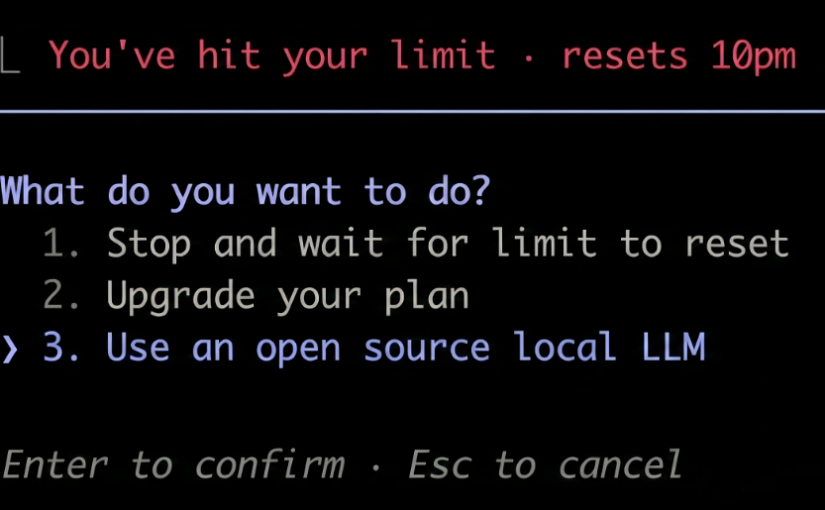
If you’re on one of the cheaper Anthropic plans like me, it’s a pretty common scenario when you’re deep into Claude coding an idea, to hit a daily or weekly quota limit. If you want to keep going, you can connect to a local open source model instead of Anthropic. To monitor your current quota, type: /usage
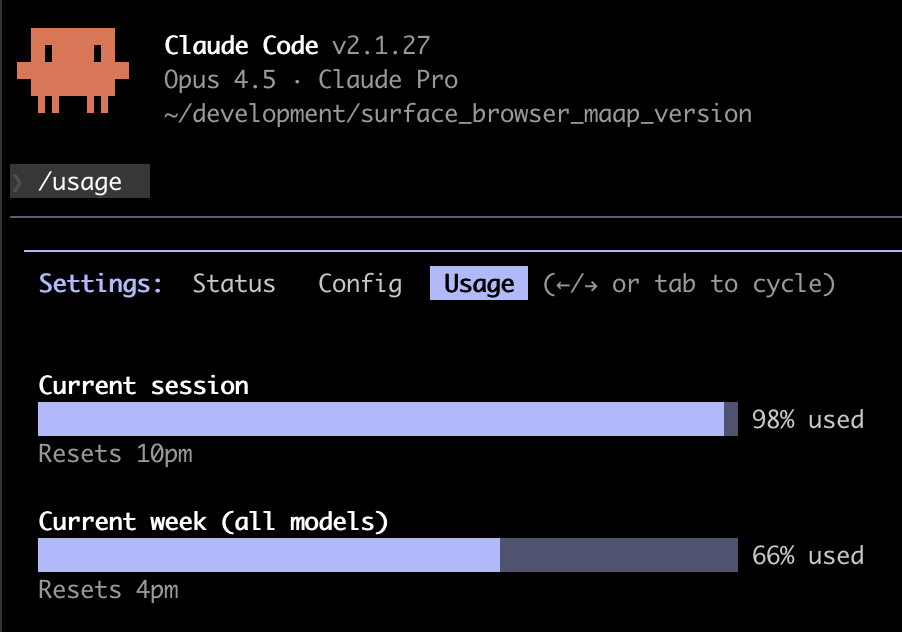
Type /usage to monitor how much quota you have left and how quick you burn it.

The best open source model is changing pretty frequently, but at the time of writing this post, I recommend GLM-4.7-Flash from Z.AI or Qwen 3. If you want or need to save some disk space and GPU memory, try a smaller quantized version which will load and run quicker with a quality cost. I’ll save another detailed post for how to find the best open source model for your task and machine constraints.

Method 1: LM Studio
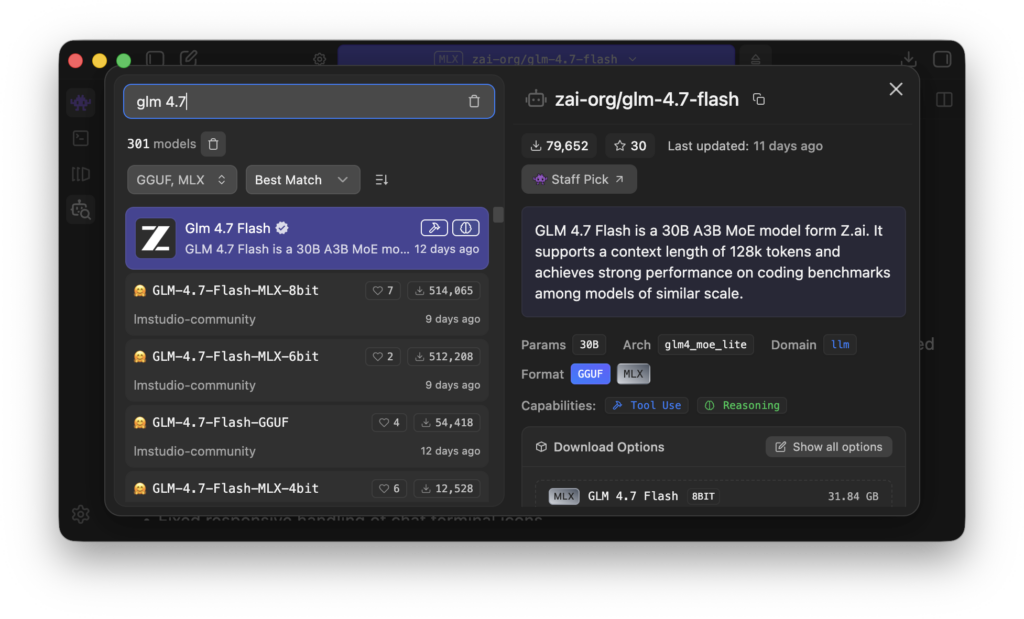
Accessing open source models in LM Studio

If you haven’t used LM Studio before, it’s an accessible way to find and run open source LLMs and vision models locally on your machine. In version 0.4.1, they introduce support to connect to Claude Code (CC). See here: https://lmstudio.ai/blog/claudecode or follow the instructions below:

  1. Install and run LM Studio
  2. Find the model search button to install a model (see image above). LM Studio recommends running the model with a context of > 25K.
  3. Open a new terminal session to:
    a. start the server: lms server start --port 1234
    b. configure environment variables to point CC at LM Studio:
    export ANTHROPIC_BASE_URL=http://localhost:1234
    export ANTHROPIC_AUTH_TOKEN=lmstudio
    c. start CC pointing at your server: claude --model openai/gpt-oss-20b
  4. Reduce your expectations about speed and performance!
  5. To confirm which model you are using or when you want to switch back, type /model
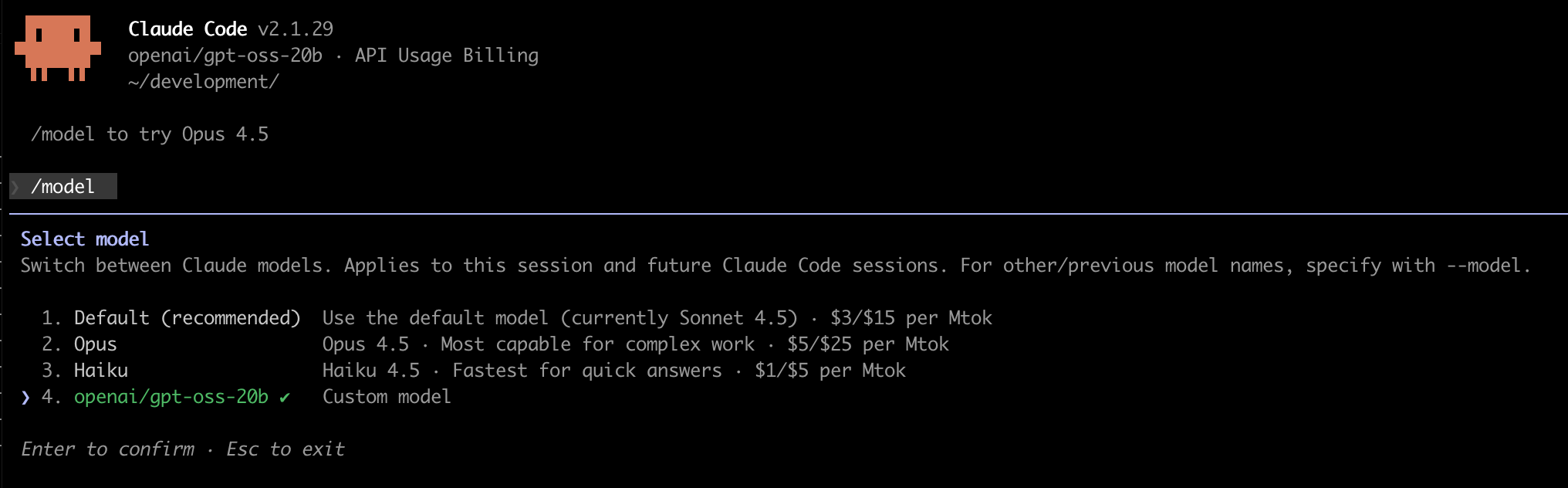
Enter /model to confirm which model you are using or to switch back

Method 2: Connecting directly to Llama.CPP

LM Studio is built on top of the open source project llama.cpp.
If you prefer not to use LM Studio, you can install and run the project directly and connect Claude Code to it but honestly, unless you are fine tuning a model, or have really specific needs, probably LM Studio is going to be a quicker setup.

Conclusion

For the moment, this is a backup solution. Unless you have a monster of a machine, you’re going to notice the time it takes to do things and a drop in code quality but it works(!) and it’s easy enough to switch between your local OSS model and Claude when you’re quota limit is back, so it’s a good way to keep coding when you’re stuck or you just want to save some quota. If you try it let me know how you go and which model works for you.

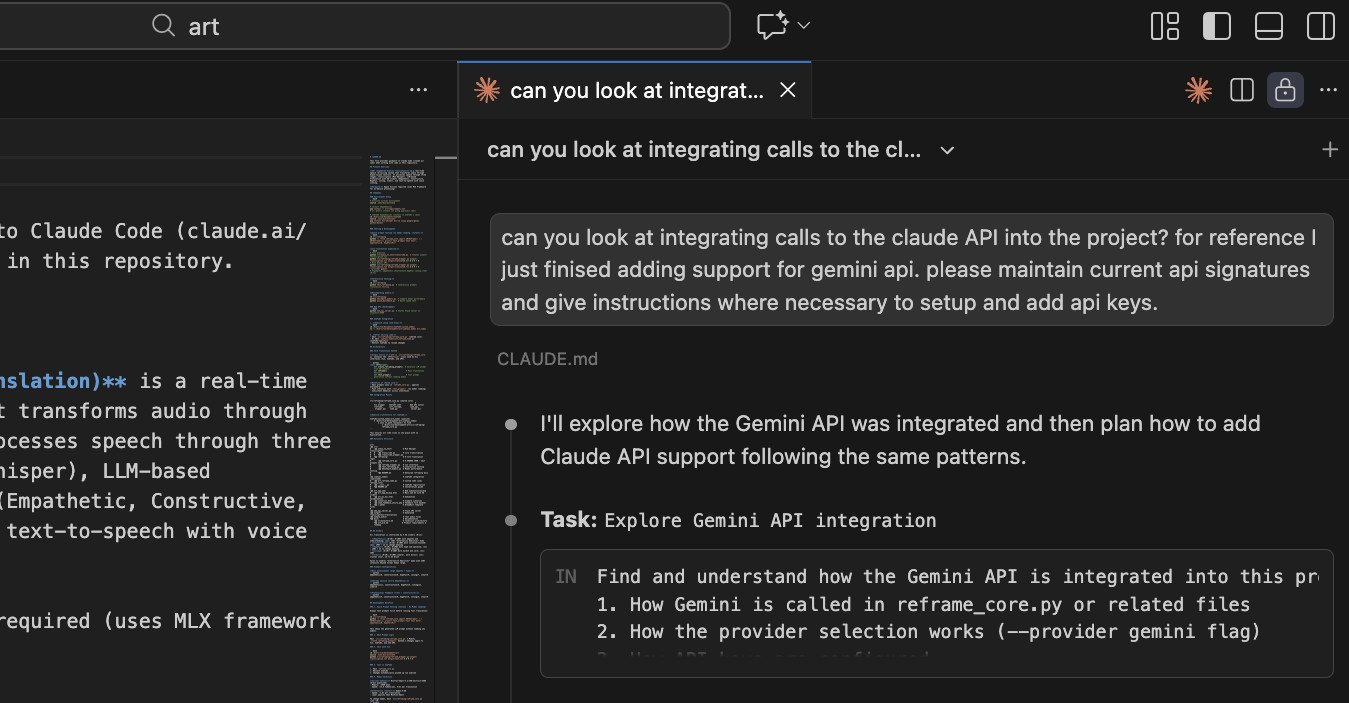
Ways to Claude Code

If you want to experiment with Claude Code, below is an overview of the options I’ve tried, and when each one makes sense.

1. Run Claude Code from the terminal

Refer to Claude Code docs for prerequisites on getting started, open your terminal program and enter:
curl -fsSL https://claude.ai/install.sh | bash

Once installed, navigate to your new project folder and run:
claude

This works well if you want the experience to be more “agentic”, less a coding partner and you are familiar with a terminal.

Claude Code running in a terminal

2. VS Code integration

If you prefer to work with Claude Code as a collaborator, you can integrate it directly in VS Code (or Cursor, Windsurf or JetBrains IDEs) via the extension from Anthropic. It’s still the CLI app underneath, but you get better visibility into changes and a more editor-native experience so you can review and make changes easily. If you’re coming from Cursor, this will feel familiar to how you were working.

Claude Code in VS Code

2b. Other IDEs: Antigravity and Cursor

You can code with Claude models also in Google’s Antigravity and Cursor’s IDE. The interface is slightly different and the usage quotas have reduced but if you already have an account, there’s no reason not to jump between tools. Make sure to keep your project documentation up to date!

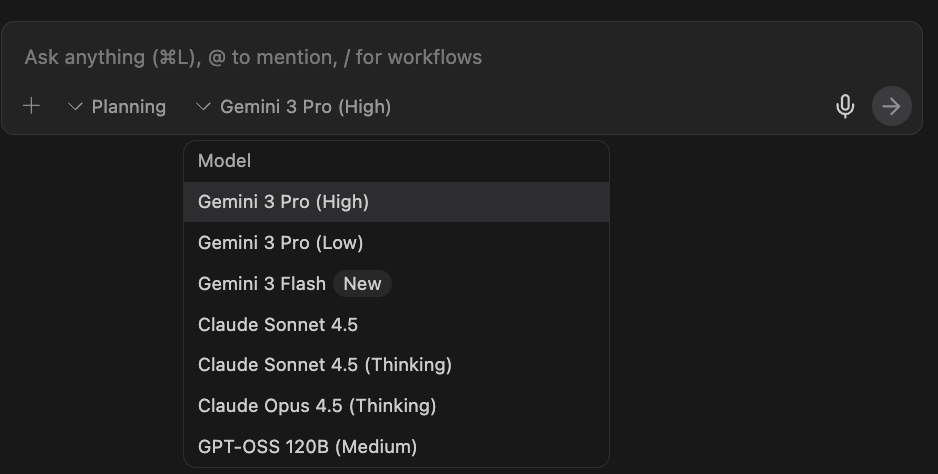
Accessing Claude models via Antigravity

3. Claude Code in the browser

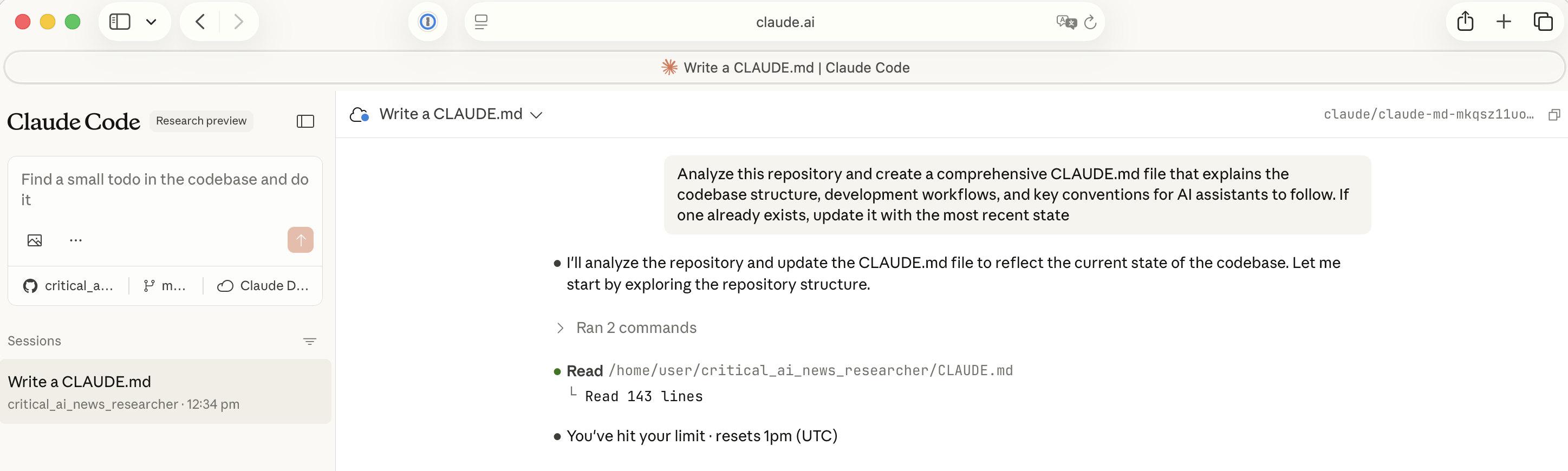
Lastly, if your codebase is in an online accessible repo, you can run Claude Code in the browser at: https://claude.ai/code
You can also choose to give it access to your private repos in GitHub.

Claude Code running in browser

Wrap-up

With that I’ve hit my usage limit.. which brings me to my next post: Running with local models! Please let me know how you Claude Code in the comments, especially if I missed the way you use it.

Ready for my close-up (single shot music video clip)

Janelle Monae – Cold War
Dir. Wendy Morgan (2010)

Radiohead – No Surprises
Dir. Grant Gee (1998)

Watch for the small smile after he emerges from the water.

Björk – Hunter
Dir. Paul White (1997)

Björk transmogrifying into a cyber-elf-bear. I mean, don’t we all feel like that when head-shake dancing? Just not as adorable as Björk.

Honourable mentions

Bob Dylan – Subterranean Homesick Blues (1965)
Dir. Dylan with D. A. Pennebaker: Documentary: Dont Look Back (1967)

Possibly the first music video clip also with partial cue card narration.

Sinéad O’Connor – Nothing Compares 2 U
Dir. John Maybury (1990)

U2 – Numb
Dir. Kevin Godley (1993)

Alanis Morissette – Head Over Feet
Dir. Michelle Laurita (1997)

LCD Soundsystem – All My Friends
Dir. Jon Blistein (2007)

Lorde – Tennis Court
Dir. Joel Kefali (2013)

Billie Eilish – when the party’s over
Dir. Carlos López Estrada (2018)

If you like these, there’s a whole genre of one shot music clips which are also technically amazing but not necessarily as intense as these. See Michel Gondry’s Kylie Minogue clip, Moloko, OK Go, Feist, Spice Girls….

Cooking with Covid-19

Covid-19 has impacted us all but so differently; imperceptible for some yet devastating for others. If you are unlucky enough to catch it, one common symptom is “anosmia” or smell blindness.

Here are some recipes I enjoyed with a focus on texture:

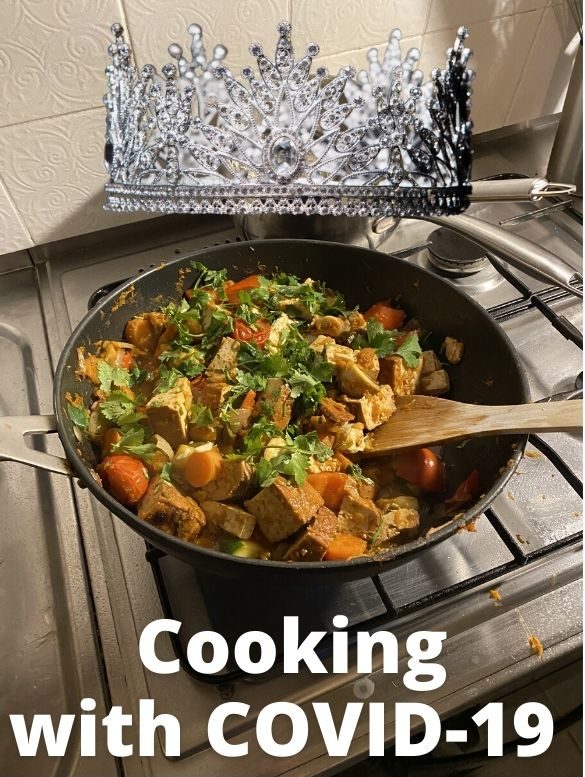
Cooking with COVID-19Stir-Fry Veggies and Smoked Tofu: throw together a bunch of roughly chopped onions, garlic, ginger, chilli, fresh veggies: carrots, capsicum, and mushrooms. Add in big cubes of smoked tofu, snow peas, coriander and lime towards the end of cooking. Optional: crushed cashews, fish sauce, hoisin sauce, chilli sauce, and noodles.
Baked Veggies and pan-fried chicken breast: not sure why but the carby goodness of baked potatoes combines with the texture of pan-fried protein perfectly for a really nice mouth-feel.

Pastel de Nata: simplicity is king: the custard, sweetness and texture of the pastry make this a great dessert.

We tried a bunch of recipes over the course of the illness. Fish fingers were also a favourite for simplicity. Fondue was ok. We joked about eating old socks and raw onions but didn’t get to that point. In short, this is not the time to eat gourmet chocolate or choice cuts of meat: you won’t taste the difference, so focus on the texture and simple mouth flavours. Good luck!

Disclaimer: There is no info in this post on how to destroy, recover from, contract, or spread coronavirus.

Penne alla Montanara Svizzera

  1. Make a Napolitano sauce base (onion, garlic, oregano, tomatoes)
  2. Cook pasta and potato: 3/4 Penne and 1/4 potatoes. (We used boiled potatoes left over from Rösti so added near the end of cooking the pasta)
  3. Add chopped thin Swiss or Italian cooked (not raw) pork sausage (we got ours from Metzgerei Zgraggen in Zürich “Schweinswurstchen“ – they’re the best ) five minutes before finishing to the sauce
  4. Serve and top with generous amount of Gruyère/Vacherin grated fondue cheese and pepper

This is an accidentally good Sunday/comfort recipe after we had made some Swiss dishes Fondue and Rösti so had left-over fondue cheese mix and potatoes (a bit inspired by Älplermagronen pasta and potato mix).

Sleep better by dimming your iPhone and iPad like f.lux

f.lux is great software to reduce night time screen use affecting your sleep. Unfortunately it’s not possible to install on iOS unless you jail break your device.

iOS now comes with a wonderful built-in alternative hidden in the Accessibility settings to let you dim the screen past the normal range of the brightness control.

iOS 9: Settings > General > Accessibility > Zoom

  1. Set zoom filter to low light
  2. Set max zoom level down to 1.2
  3. Switch zoom on (screen should dim and zoom in)
  4. Double tap with 3 fingers and drag to set zoom to 1:1 (this is a bit tricky)
  5. Go to Settings > General > Accessibility > Accessibility shortcut — set to Zoom

Now you can triple click the home button to switch screen dimming on and off.

iOS 8: is slightly more hidden — follow this video for instructions:

Android has some good clones of f.lux — I use Lux Auto Brightness.

Thank you! >> iPhone Brightness Button Toggle Hack | lifehacker: ​Toggle Your iPhone’s Brightness With a Home Button Triple Tap

Adobe CS4: Fix! // Licensing for this product has stopped working Error – 150:30

I upgraded to a new Macbook, ran Migration Assistant, then started Photoshop to be greeted with this error. Tried de-activating on my old laptop etc.

Adobe info. The Adobe Licensing Repair Tool doesn’t work on OS X 10.7 Lion or OS X 10.8 Mountain Lion.

Recommendation from forum post:

  1. Download and mount the utility.
  2. Open Terminal, cd to the volume \mac_install_11.6.1 and run sudo ./install_fnp.sh

Download links to Adobe trials: CS3, CS4, CS5, CS6 if clean reinstalling.

Update 1: Yes I upgraded to CS6 now Retina support is available and use CC at work.. Thanks Adobe.

Update 2: macOS Sierra CS6 refer to Adobe instructions.

Bookmarks for February 5th through February 10th

These are my links for February 5th through February 10th: